> For the complete documentation index, see [llms.txt](https://docs.prismacloud.io/llms.txt). Markdown versions of documentation pages are available by appending `.md` to page URLs; this page is available as [Markdown](https://docs.prismacloud.io/content-collections/alerts/suppress-alerts-for-prisma-cloud-anomaly-policies.md).
# Suppress Alerts for Prisma Cloud Anomaly Policies
Exclude resources from generating anomaly alerts on Prisma Cloud.
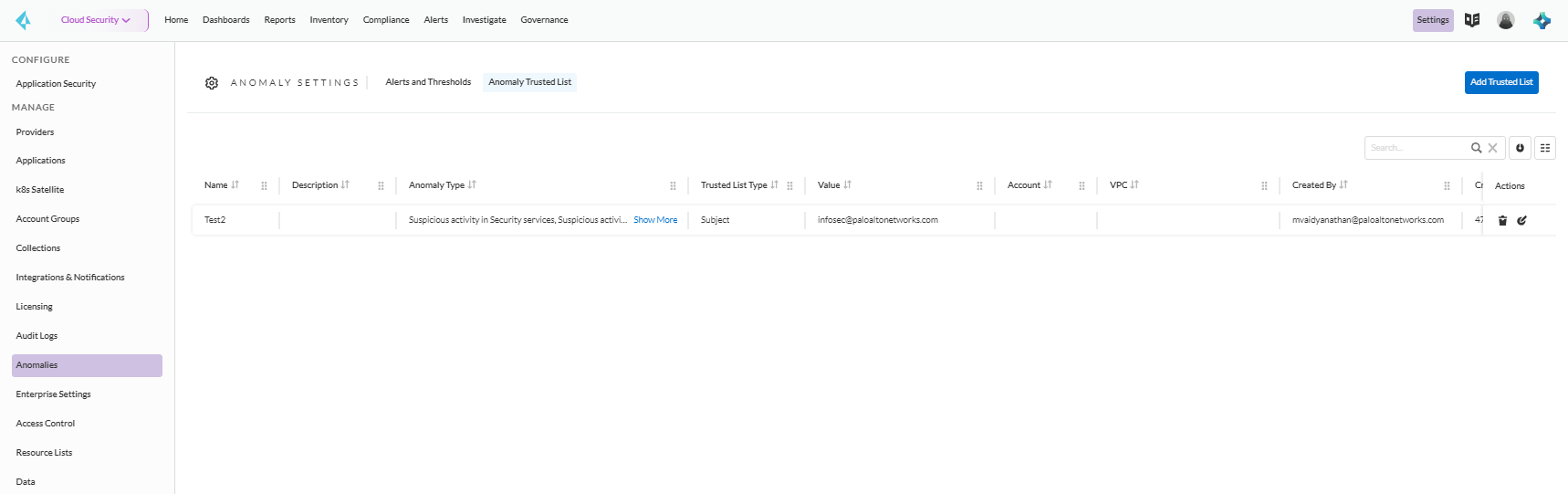
Use the **Anomaly Trusted List** to include the list of resources for which you do not want Prisma Cloud to generate [Anomaly Policies](/content-collections/governance/anomaly-policies.md#id31e46cf0-ad50-471b-b517-6a545b57521e) alerts.
Within a list, you can choose the resource type or identifier such as cloud service name, domain, IP address, machine image ID, port, protocol, resource ID, subject name, or tag for which you want to suppress alerts and apply the list to a set of anomaly policies.
Only users granted Policies Read permissions are able to view the Anomaly Trusted List on the Prisma Cloud administrative console. Navigate to **Settings > Access Control** to add the required permissions to view the Anomaly Trusted List.
1. Select **Settings > Anomalies > Anomaly Trusted List**.
You must have the correct role, such as the System Administrator role, on Prisma Cloud to view or edit the Anomaly Settings page. See [Prisma Cloud Administrator Permissions](/content-collections/administration/prisma-cloud-admin-permissions.md) for the roles that have access.
2. Click **Add Trusted List**.
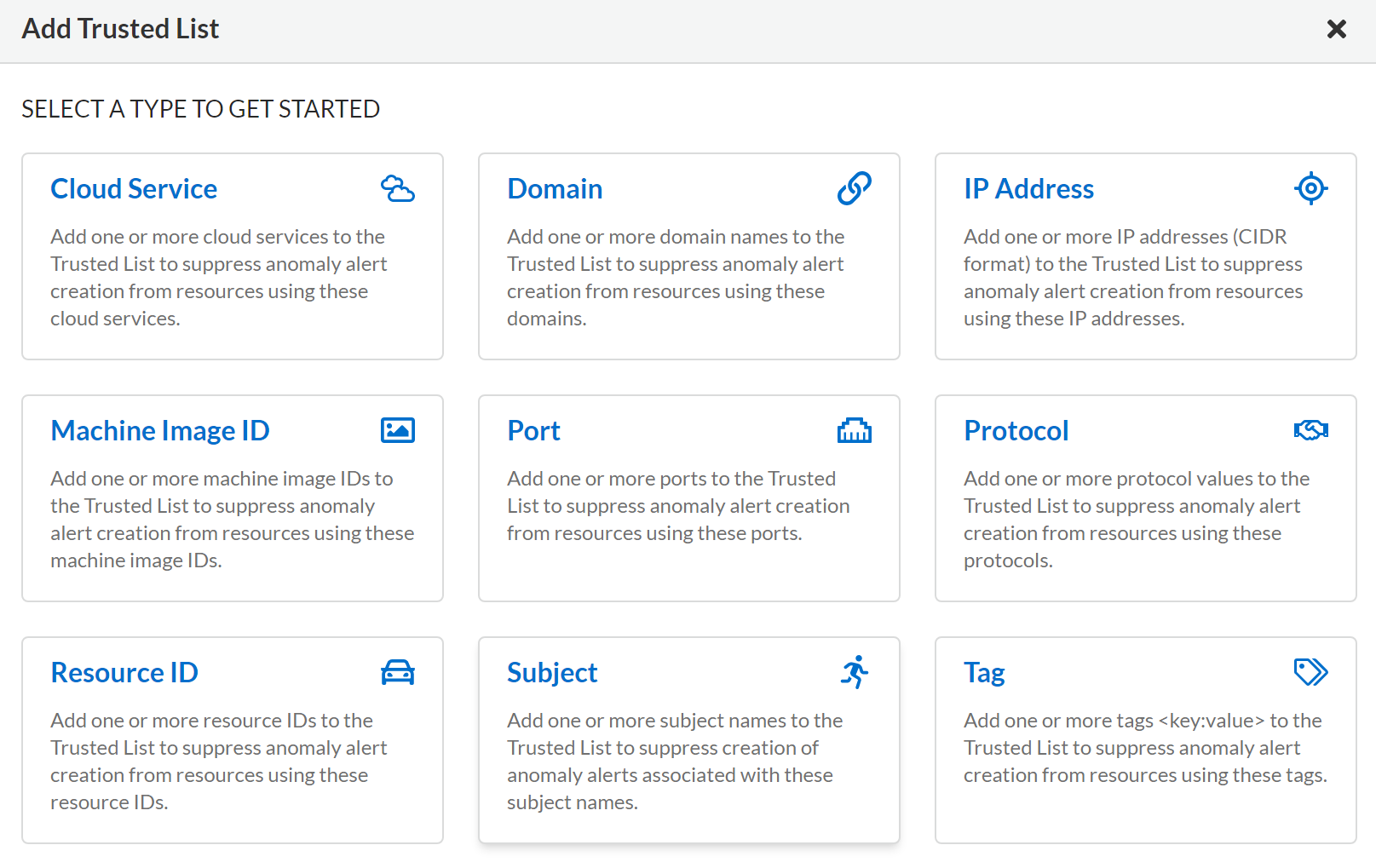
3. Select the resource type and click **Next**.
Choose the resource type or identifier such as cloud service name, domain, IP address, machine image ID, port, protocol, resource ID, subject name, or tag. For adding an IP address to the list, see [Trusted IP Addresses on Prisma Cloud](https://github.com/PaloAltoNetworks/pc-docs-md/tree/main/enterprise-edition/content-collections/administration/trusted-ip-addresses-on-prisma-cloud.md#ide7e2d4b6-c677-4466-a0b0-befc62fb0531).
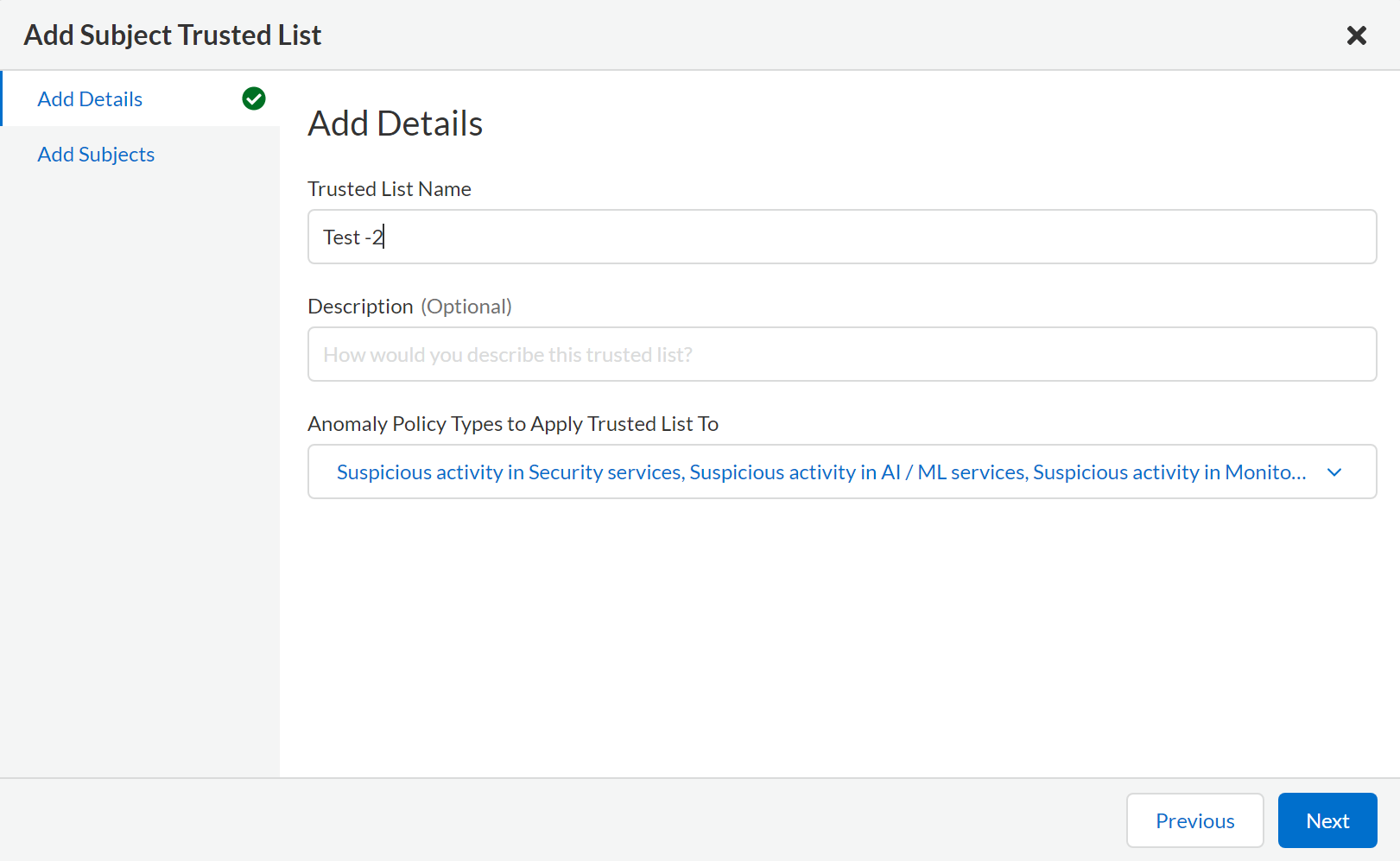
4. Enter a **Trusted List Name** and, optionally a **Description**.
5. Select the Anomaly Policies for which you do not want to generate alerts.
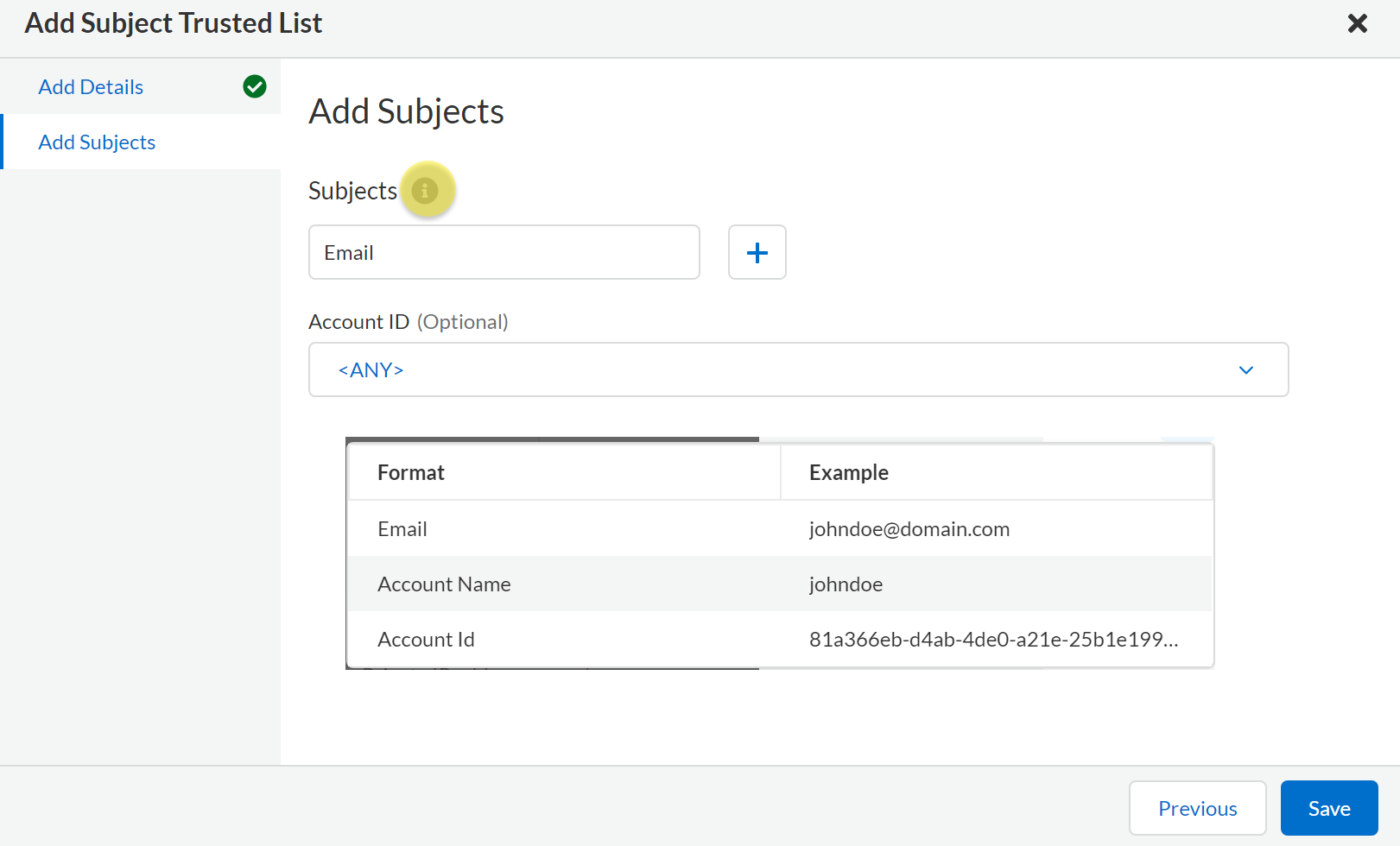
6. Enter the value for the resource type you selected.
For each resource type, refer to the [Resource Syntax for Trusted List](#id47fecd66-ebcf-4d0b-9c05-a4948ef28a0e) for details on the supported values. By default, the entries you add to the trusted list are excluded from generating alerts against any (all) cloud accounts that are onboarded to Prisma Cloud. If you want to select a specific cloud account, select an **Account ID** and \*VPC ID\*or set it to Any to exclude any account that is added to Prisma Cloud.
7. **Save** the list.
When you save the list, for the selected anomaly policies Prisma Cloud will not generate alerts for the resources included in this list.
Only the administrator who created the list can modify the name, description, Account ID and VPC ID; other administrators with the correct role can add or delete entries on the trusted list.
## Resource Syntax for Trusted List
Use RQL to view the resource configuration meta data on the **Investigate** page. The following table provides a few examples.
| **Resource Type** | **Resource URL** | **Value in the Trusted List** | **Description** |
| ---------------------- | -------------------------------------------------------------------------------------------------------------------------------------------------------------------------------------------------------------------------------------------------------------------------------------------------- | --------------------------------------------------------------------------------------------------------------------------------------------------------------------------------------- | -------------------------------------------------------------------------------------------------------------------------------------------------------------------------------------------------------------------------- |
| **Resource ID** | | | |
| AWS Resource ID | /investigate/details?resourceId=rrn::instance:us-east-1:349006084872::i-05c2e0a4cbc970575 | i-05c2e0a4cbc970575 | Last value in resource URL |
| GCP Resource ID | /investigate/details?resourceId=rrn::instance:us-central1:lilit-3:ee45f1eebc4f436939f89374e8d9c33fe4485718:7923637926488106011 | 7923637926488106011 | Last value in resource URL |
| Azure Resource ID | /investigate/details?resourceId=rrn::instance:eastus:06f9b271-fa8f-44c3-b597-f3af54ca770d::282b247f-9a03-412a-91e2-afc0c4bbadfb-%2Fsubscriptions%2F06f9b271-fa8f-44c3-b597-f3af54ca770d%2FresourceGroups%2Flilit-ds-resources%2Fproviders%2FMicrosoft.Compute%2FvirtualMachines%2Fds-dnd-lilit-NSG | 282b247f-9a03-412a-91e2-afc0c4bbadfb-/subscriptions/06f9b271-fa8f-44c3-b597-f3af54ca770d/resourceGroups/lilit-ds-resources/providers/Microsoft.Compute/virtualMachines/ds-dnd-lilit-NSG | URL Decoded version of last value in resource URL |
| **Machine Image ID** | | | |
| AWS Machine Image ID | "imageId": "ami-0a0ddd875a1ea2c7f" | "ami-0a0ddd875a1ea2c7f" | value for the key imageId in resource json |
| GCP Machine Image ID | NOT SUPPORTED | NOT SUPPORTED | NOT SUPPORTED |
| Azure Machine Image ID | "properties.storageProfile": { "imageReference": { ""sku"": "2019-Datacenter", "offer": "WindowsServer", "version": "latest", "publisher": "MicrosoftWindowsServer" } }" | MicrosoftWindowsServer-WindowsServer-2019-Datacenter-latest | Join the following using a ""-""vm.storageProfile().imageReference().publisher(),vm.storageProfile().imageReference().offer(),vm.storageProfile().imageReference().sku(),vm.storageProfile().imageReference().version());" |
| **Tags** | | | |
| AWS | """tags"": \[ { ""key"": ""Name"", ""value"": ""Flowlogs-Automation-2"" }]" |
Key = Name
Value = Flowlogs-Automation-2
| Provide the key and value as-is |
| Azure | """tags"": { ""items"": \[ ""http-server"" ]}" | Key = http-server | Provide the value from items list as the key. Value is not needed |
| GCP | """tags"": { ""purpose"": ""ds-flowlogs-bucket"" }" |
Key = purpose
Value = ds-flowlogs-bucket
| Provide the key from the json element as key and the value from json element as the value |
| **Cloud Service** | | | |
| AWS Service | s3.amazonaws.com | s3.amazonaws.com | as is |
| GCP Service | compute.googleapis.com | compute.googleapis.com | as is |
| Azure Service | microsoft.compute | microsoft.compute | as is |
---
# Agent Instructions
This documentation is published with GitBook. GitBook is the documentation platform designed so that both humans and AI agents can read, navigate, and reason over technical content effectively. Learn more at gitbook.com.
## Querying This Documentation
If you need additional information that is not directly available in this page, you can query the documentation by asking a question.
Perform an HTTP GET request on the following URL with the `ask` and `goal` query parameters:
```
GET https://docs.prismacloud.io/content-collections/alerts/suppress-alerts-for-prisma-cloud-anomaly-policies.md?ask=&goal=
```
`ask` is the immediate question: it should be specific, self-contained, and written in natural language.
`goal` is what the user is ultimately trying to achieve, the reason they need the answer. Sharing it helps GitBook give you a better, more relevant answer. A goal is most helpful when it describes the outcome the user wants rather than restating the question. For example, with `ask=how do I create an API token`, a goal like `automate deployments from our CI pipeline` lets GitBook tailor the answer to that use case.
The response will contain a direct answer to the question and relevant excerpts and sources from the documentation.
Use this mechanism when the answer is not explicitly present in the current page, you need clarification or additional context, or you want to retrieve related documentation sections.